
A Preliminary Risk Assessment of Geomagnetically Induced Currents over the Italian Territory
Papers from SWICo members
Authors:
Roberta Tozzi, Paola De Michelis, Igino Coco, Fabio Giannattasio
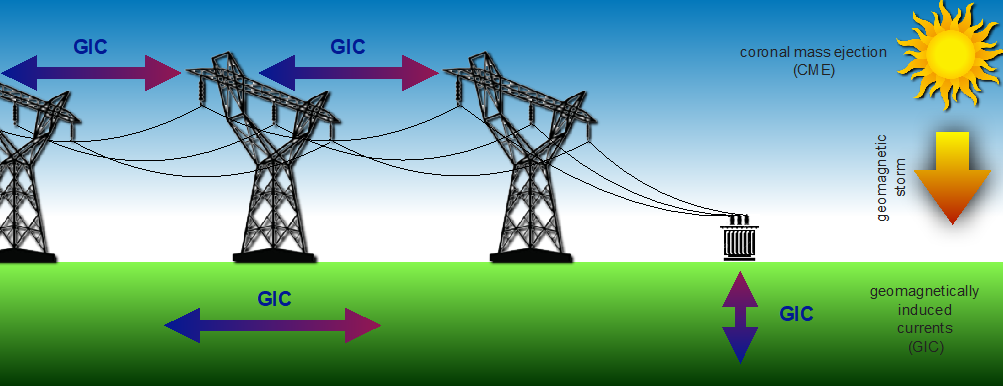
Major geomagnetic storms drive rapid intensification and variability of magnetospheric and ionospheric current systems that give rise to large ground geomagnetically-induced currents (GIC). Space weather associated GIC pose a serious threat to the reliability of power-transmission systems and other electrically conducting infrastructures such as oil and gas pipelines. The most severe effects are observed at high latitudes due to ionospheric currents associated with the aurora. However, as power transmission grid and pipeline infrastructures continue to grow at middle and low-latitudes, GIC hazards are no longer just concerns of high-latitude regions.
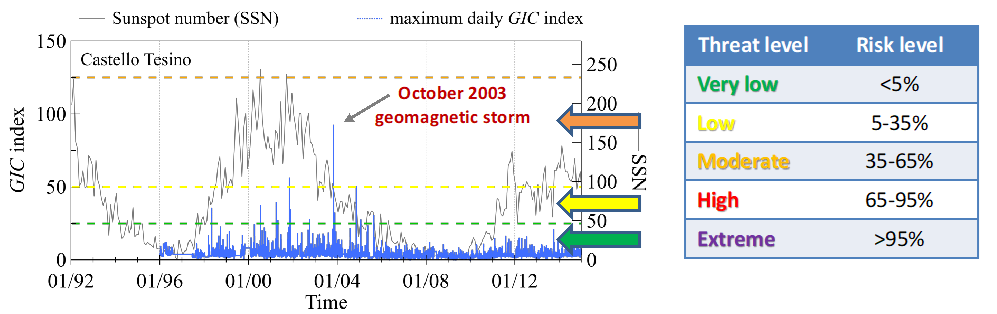
We provide a preliminary characterisation of the general risk to which the Italian power grid network is exposed. Due to limited direct GIC measurements, a proxy of the geoelectric field is used, i.e. the GIC index. This is calculated for a time interval of approximately 20 years using data from the two longest running Italian magnetic observatories, i.e. Castello Tesino and L’Aquila. Results show that during periods of high geomagnetic activity, potentially detrimental GICs could flow through the power network, especially at the highest Italian latitudes that are characterized by a low conductivity lithosphere.
Publication: Tozzi, R., De Michelis, P., Coco, I., Giannattasio, F., 2019. A Preliminary Risk Assessment of Geomagnetically Induced Currents over the Italian Territory, Space Weather, 17, 46-58, doi: 10.1029/2018SW002065. https://agupubs.onlinelibrary.wiley.com/doi/full/10.1029/2018SW002065
More information:
http://www.lescienze.it/news/2011/08/11/news/il_ritorno_della_grande_aurora-551058/
https://www.swpc.noaa.gov/content/education-and-outreach
Single-spacecraft Identification of Flux Tubes and Current Sheets in the Solar Wind
Papers from SWICo members
Authors:
F. Pecora, A. Greco, Q. Hu, S. Servidio, A. Chasapis, W. H. Matthaeus
In this work we present a novel technique, based on two consolidated models, for describing and visualising the local topology of the magnetic field solar wind using single-spacecraft data. The Grad-Shafranov (GS) reconstruction method provides a two-dimensional map of the magnetic field surrounding the spacecraft trajectory, while the Partial Variance of Increments (PVI) technique is able to identify coherent magnetic structures, such as current sheets. We applied this combined technique to one month of magnetic field data measured by Wind satellite at 1 AU. In this stream we selected the flux rope events, that are structures with cylindrical symmetry and a relatively strong magnetic field along the symmetry axis. These flux tubes are quite large structures (a fraction of AU) and have a complex inner structure and they interact each other while moving in the Solar Wind.
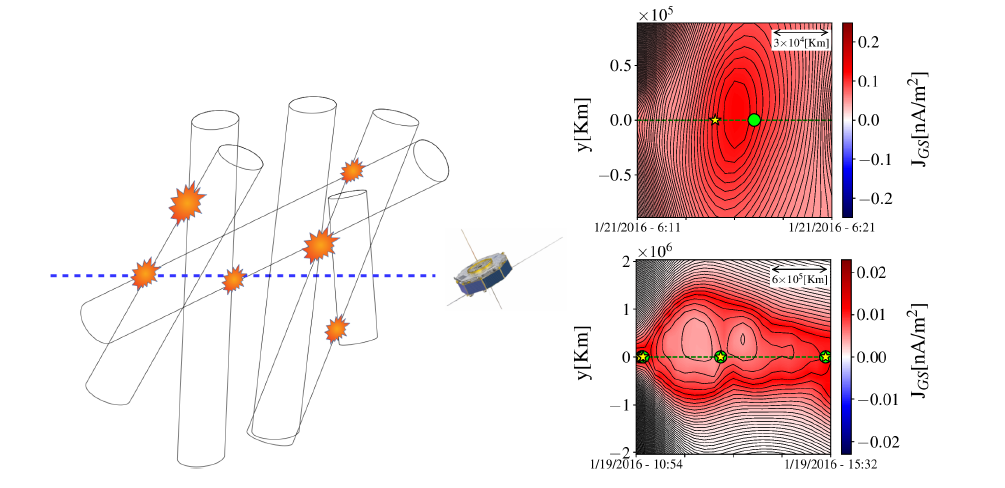
These inner and outer interactions can possibly generate sites of magnetic reconnection where strong current sheets appear. What we observed from the reconstruction is that a quasi-two-dimensional turbulence emerges as a sea of nested magnetic islands with current sheets located mostly at their boundaries. The method shows great promise for visualising and analysing single-spacecraft data from missions such as Parker Solar Probe and Solar Orbiter, as well as 1 AU SpaceWeather monitors such as ACE, Wind, and IMAP.
Publication: Pecora F., Greco A., Hu Q., Servidio S., Chasapis A. G., Matthaeus W. H., 2019, ApJL, 881, L11. doi:10.3847/2041-8213/ab32d9
https://iopscience.iop.org/article/10.3847/2041-8213/ab32d9
Forecasting the 2018 February 12th CME propagation with the P-DBM model: a fast warning procedure
Papers from SWICo members
Authors:
Dario Del Moro, Gianluca Napoletano, Roberta Forte, Luca Giovannelli, Ermanno Pietropaolo, Francesco Berrilli
The forecast of the time of arrival of a Coronal Mass Ejection (CME) to Earth is of critical importance for our high−technology society and for the Earth’s upper atmosphere status and LEO satellites. We realized a procedure based on the Drag−Based Model which uses probability distributions, rather than exact values, as input parameters, and allows the evaluation of the uncertainty on the forecast. The P−DBM belongs to a family of models that apply a somewhat simplified description of the main interaction the ICME is subject to during its interplanetary journey. The drag−based models (DBMs) assume that beyond a certain heliospheric distance, a simple aerodynamic drag equation can describe the interaction between the ICME and the solar
wind environment.
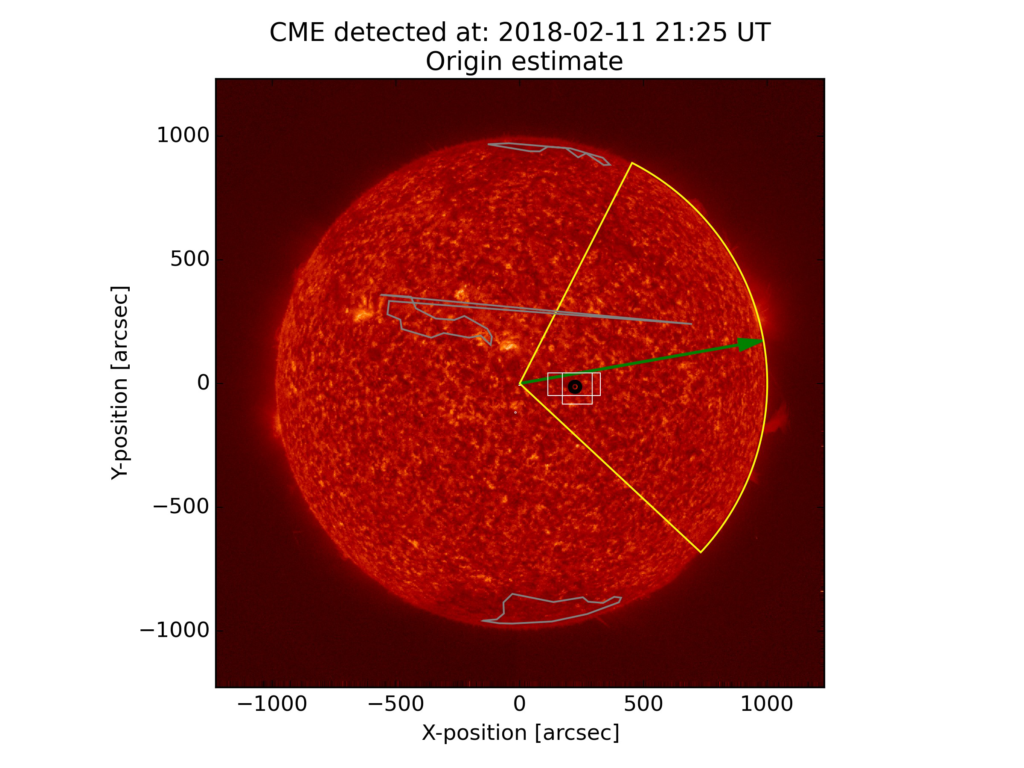
Ensemble modeling incorporate the intrinsic limitation of information due to measure errors or due to the lack of measure at all, in form of probability distributions. In practice, instead of a single run to forecast an ICME propagation, a set of runs, driven with input parameters extracted from suitable distributions are used to retrieve a distribution of output parameters. We tested this approach using a set of CMEs whose transit times are known, obtaining extremely promising results.
We realized a real−time implementation of this algorithm which ingests the outputs of automated CME tracking algorithms as inputs to provide early warning for those CME approaching Earth. We present the results of this real−time fast warning procedure for the case of the 2018 February 12th
CME.
Publication: DEL MORO, Dario et al. Forecasting the 2018 February 12th CME propagation with the P-DBM model: a fast warning procedure. Annals of Geophysics, [S.l.], v. 62, n. 4, p. GM456, dec. 2019. ISSN 2037-416X.
https://www.annalsofgeophysics.eu/index.php/annals/article/view/7750
Can superflares occur on our Sun?
Papers from SWICo members
Authors:
Paolo Romano, Abouazza Emhamdi, Ayman Kordi
Two strong homologous white light flares of X-GOES class occurred on the Sun on Sept. 06, 2017, providing a rare exceptional opportunity to study the mechanisms responsible for the formation of the magnetic field configurations suitable for the manifestation of such yet enigmatic eruptive events and their effects in the lower layers of the solar atmosphere.
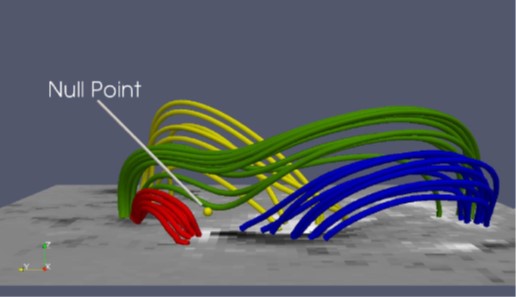
Using photospheric vector magnetograms, taken before the beginning of the two X-class events, as boundary conditions to reconstruct the non−linear coronal magnetic field configuration, we identified two related 3D null points located at low heights above the photosphere (i.e. in very low corona). These null points are most likely responsible for the triggering of the two strong X-GOES class flares. We deduced that their formation at such low altitudes may plausibly be ascribed to the peculiar photospheric horizontal motions of the main magnetic structures of the hosting Active Region NOAA 12673.
These events can be adopted as a hint for a possible interpretation of the activity of young G-type stars, recently reported by the Kepler mission, and can shed light on the probability that superflares occur on our Sun.
Publication: Two Strong White-Light Solar Flares in AR NOAA 12673 as Potential Clues for Stellar Superflares, Solar Physics, 294, 4, 2019
https://link.springer.com/article/10.1007/s11207-018-1388-0
SOLARNET school March 23-27, MSSL – Call for Applications
The call for application is open for the SOLARNET school “A holistic view of the solar atmosphere – combining space and ground-based observations”
Dates, venue: March 23-27, 2020 at UCL – Mullard Space Science Laboratory (Dorking, UK)
The school “A holistic view of the solar atmosphere – combining space and ground-based observations” has for a goal to provide an introduction to the approaches and analysis methods needed to successfully combine space and ground-based observations of the solar atmosphere from the photosphere to the corona, in order to a complete view of the underlying physical processes at work in a range of different solar phenomena.
To apply for the SOLARNET school, please send to g.valori@ucl.ac.uk no later than February 25, 2020
- a one-page CV
- a brief statement of interest (max. 1/2 page) indicating your field of research and why you want to participate in the school.
Web Links (more information will appear in due course): https://solarnet-project.eu/Schoolshttps://solarnet-project.eu/A-holistic-view-of-the-solar-atmosphere
Course on “Dynamical Systems and Machine Learning Approaches to Sun-Earth Relations”
The International School of Space Science of the Consorzio Interuniversitario per la Fisica Spaziale organizes a Course on “Dynamical Systems and Machine Learning Approaches to Sun-Earth Relations”, to be held in L’Aquila, Italy, 15-19 June 2020, directed by G. Consolini, D. Del Moro.
The course is devoted to young researchers and PhD students and will provide an introduction and an overview of the recent theoretical, numerical and data analysis advances in the framework of dynamical systems and machine learning approaches to the characterisation and the modelling of Sun-Earth’s relations.
The dynamics of the Sun strongly affects the interplanetary and circumterrestrial environment, causing phenomena that have a great impact on the anthropic activities. In the past, the response of the Earth’s magnetosphere-ionosphere system to the changes of the solar wind and interplanetary conditions due to the solar activity has been widely investigated showing that the dynamics of the coupled solar wind-magnetosphere-ionosphere (SMI) system resembles that of a complex system displaying scale invariant features, turbulence and a near-criticality behaviour. On the other hand, in the framework of dynamical systems, several new tools and methods have been proposed to quantify and characterise the dynamical complexity and its role in nonlinear out-of-equilibrium dynamical systems.
Furthermore, the modelling of the complex dynamics of the SMI system, as such as some features of the solar activity has been shown to benefit from the recent advances in the field of machine learning techniques.
The course will consist in theoretical lectures and laboratory exercitations.
Applications are due before February 29, 2020.
For more information visit http://www.cifs-isss.org/ or send an e-mail to ssc@aquila.infn.it
European Solar Physics Division (ESPD) – 2020 Prizes: First Call for Nominations
Deadline: February 1st, 2020
Since 2017, the European Solar Physics Division (ESPD) of the European Physical Society (EPS) awards three prizes: the ESPD PhD Thesis Prize, the ESPD Early Career Researcher (Postdoc) Prize and the Senior Prize. These prizes are nomination-based. The deadline for nomination is February 1st, 2020.
The 2020 ESPD PhD Thesis Prize will be awarded to a young researcher whose PhD thesis/viva was defended in 2019.
The 2020 ESPD Early Career Prize will be awarded to a young researcher whose PhD was awadered after 01/01/2016 (with possible extension).
The 2020 ESPD Senior Prize will be awarded to a distinguished senior scientist for a life-long prolific career.
Further information about eligibility, documents to be included in the nomination package, and submission process for each prize can be found on the ESPD prizes webpage:
https://www.eps.org/members/group_content_view.asp?group=85203&id=641304#CallPrize
Primo Congresso della Space Weather Italian Community (SWICo)

Dal 12 al 13 febbraio 2020 si terrà il “Primo Congresso della Space Weather Italian Community (SWICo)” presso la sede dell’ASI a Roma (https://swico2020.roma2.infn.it/). Il Congresso tratterà dello Space Weather sia negli aspetti scientifici che in quelli applicativi e organizzativi. Durante il convegno si terrà anche l’Assemblea Nazionale SWICo. Il convegno è aperto anche a ricercatori e tecnologi non aderenti a SWICo e sono incoraggiati la presenza e il contributo di studenti e dottorandi. La deadline per la sottomissione di abstract e iscrizioni on-line è il 16 dicembre 2019.
Doctoral Researcher in Solar Physics at AIP
The Leibniz Institute for Astrophysics Potsdam (AIP) invites applications for a Doctoral Researcher in Solar Physics (f/m/d). The position is within the project »From Flux Emergence to Decay –A High-resolution Study of Sunspots« supported by the German Research Foundation (DFG).
https://www.aip.de/en/career/jobs/jobs-1/doctoral-researcher-in-solar-physics-f-m-d/
The focus of the doctoral research project is the growth and decay of sunspots using state-of-the-art multi-wavelength and multi-instrument high-resolution data in combination with state-of-the-art data handling techniques. During the doctoral studies,the successful candidate will develop expertise in solar observations, imaging and near-infrared spectropolarimetry, high-resolution imaging, spectral inversion techniques, and analysis of data from solar space missions.
We are seeking a highly motivated student with a Master degree in physics or astronomy & astrophysics with good/very good grades according to the German grading scheme for higher education. A good command of spoken and written English and basic programming skills are desirable. Genuine interest or some experience in solar physics research, astronomical observations will be highly beneficial. The doctoral student will be registered at University of Potsdam, which also grant the doctoral degree.
The appointment is a fixed-term contract for three years. The salary is based on the German public service scale (75% working time, TV-L E13), which includes employer contributions to medical and dental insurance, maternity leave and retirement benefits.
As an equal opportunity employer AIP considers individuals for employment according to their skills, abilities and experiences. Preference will be given to handicapped persons with equal competence. Women are especially encouraged to apply.
Applications for and inquiries about the doctoral position should be send to Dr. Meetu Verma preferably via e-mail to bewerbung_2019-19@aip.de. To apply, please send a single PDF file containing curriculum vitae including publications,transcripts,motivation letter including statements on education, skills and experience. If applicable, please attach separately the copies of Bachelor and/or Master Thesis. Applicants should also arrange for two letters of recommendation to be sent. Review of applications will begin 2019 October 1, and continue until the position is filled
Summer School Programme ‘Solar spectropolarimetry: From virtual to real observations’

SOLARNET is pleased to announce the call for its Summer School Programme ‘Solar spectropolarimetry: From virtual to real observations’ to be held between September 9-14, 2019, at Università della Svizzera italiana, in Lugano, Switzerland
More information on: http://solarnet-project.eu/Solar-spectropolarimetry-From-virtual-and-real-observations
Application deadline: June 30, 2019
Contact: solarnetschool1@leibniz-kis.de