
The activity of the Astroparticle Physics Group of the University of Bari Aldo Moro (commonly referred to as Gamma Group) in the Space Weather research field is focused on the analysis of high energy gamma radiation coming from the Sun and Solar System objects and detected by Fermi Gamma-ray Space Telescope.
The Fermi Gamma-ray Space Telescope, formerly GLAST, was launched on 11 June, 2008.
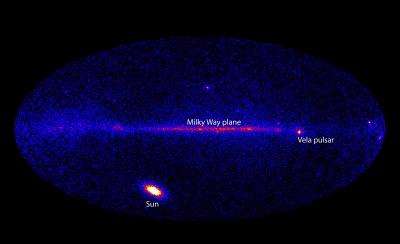
It circles Earth every 96 minutes in a 26° inclination orbit at an altitude of 535 km, allowing a scan of the entire gamma-ray sky every two orbits.
Fermi is equipped with two main instruments: the Large Area Telescope (LAT), which observes gamma rays in the energy range from approximately 30 MeV to over 300 GeV, and the Gamma-ray Burst Monitor (GBM), which detects gamma rays from 8 keV to 40 MeV primarily from transient sources such as gamma-ray bursts and solar flares.
Observations of the Sun in gamma rays are specifically performed using the LAT.
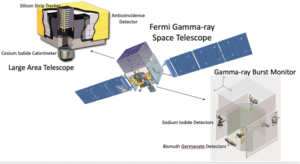
When a gamma-ray photon enters the LAT, it first encounters an anticoincidence detector (ACD), designed to reject charged particles from cosmic-ray backgrounds. The photon then passes through the tracker (TKR), which consists of alternating layers of tungsten conversion foils and silicon strip detector planes. Within this system, the gamma ray photon may interact with the tungsten and convert into an electron-positron pair via pair production.
These charged particles traverse several layers of silicon strip detectors, arranged in alternating X and Y orientations. These detectors precisely record the position of the particle tracks, enabling accurate reconstruction of the direction of the original gamma-ray photon.
Finally, the electron and positron deposit their energy in a calorimeter, which measures the total energy of the pair.
The combination of directional and energy information allows for the reconstruction of the incoming gamma ray’s energy and arrival direction with high precision.

The Fermi Large Area Telescope (LAT) has provided the most extensive sample to date of solar flares emitting gamma rays above 30 MeV, enabling unprecedented statistical studies of high-energy solar activity. These events have been documented in published flare catalogs, notably the comprehensive catalog by Ajello et al. (2021).
Fermi-LAT data enable detailed studies of temporal profiles (light curves), photon energy spectra, and the derivation of the proton spectral index for hadronic interactions. For sufficiently bright events, the LAT’s angular resolution may allow approximate localization of the flare site on the Sun.
The LAT’s continuous sky-survey mode and large field of view make it particularly suited to detecting long-duration gamma-ray emissions, which can occur hours after the impulsive phase of a flare. This capability allows the study of flare populations and their emission mechanisms across different phases of the solar cycle.
In addition to solar flares studies, observations of the quiet Sun reveal two distinct components of high-energy gamma-ray emission:
- A disk emission originating from hadronic interactions between cosmic-ray protons and nuclei in the solar atmosphere (photosphere and chromosphere),
- An extended emission produced via inverse Compton (IC) scattering of cosmic-ray electrons off solar photons, occurring throughout the heliosphere.
These observations allow us to probe two different populations of cosmic rays – protons and electrons – in regions of the heliosphere that are inaccessible to direct in situ measurements, particularly near the Sun. (Abdo+ 2011)
Thanks to Fermi-LAT’s long-term and continuous data acquisition, it has been possible to track variations in solar high-energy gamma-ray emission across different phases of the solar cycle, providing a unique view of cosmic-ray modulation near the Sun. (Acharyya+2025)

In parallel, the Gamma Group develops innovative gamma-ray detector designs, employing Geant4 Monte Carlo simulations to optimize both structural geometry and physical response characteristics of the instruments.
Reference:
Ajello, M., et al. (2021). A Decade of Gamma-Ray Bursts and Solar Flares Observed by Fermi-LAT: The 10-Year Flare Catalog. Astrophysical Journal Supplement Series, 256(1), 12. https://doi.org/10.3847/1538-4365/ac01b3
A. A. Abdo et al (2011) FERMI LARGE AREA TELESCOPE OBSERVATIONS OF TWO GAMMA-RAY EMISSION COMPONENTS FROM THE QUIESCENT SUN, Astrophysical Journal 734 116. DOI 10.1088/0004-637X/734/2/116
A. Acharyya et al (2025), Surprising Variation of Gamma Rays from the Sun over the Solar Cycle Revealed with Fermi-LAT, https://arxiv.org/abs/2505.06348